



Search engine optimization has never been static, but the last few years have introduced a more fundamental shift than most businesses realize. Search is no longer just about ranking pages. It is about how information is interpreted, summarized, and presented to users across multiple interfaces.
Traditional SEO still matters. But today, visibility can also come from featured answers, voice responses, and AI-generated summaries that appear before a single organic link is clicked.
To compete in this environment, brands need to understand three distinct but connected disciplines:
- SEO (Search Engine Optimization)
- AEO (Answer Engine Optimization)
- GEO (Generative Engine Optimization)
Each serves a different purpose. Together, they shape how your brand is discovered, referenced, and trusted.
Why the Definition of “Search Visibility” Has Changed
For many years, success in search was measured by rankings and clicks. If your page ranked well and earned traffic, the strategy worked.
That model is no longer complete.
Search engines increasingly answer questions directly on the results page. AI-driven summaries now condense information from multiple sources into a single response. Voice assistants and conversational search tools pull short, direct answers rather than full pages.
This means a user can encounter your brand without ever visiting your website.
Visibility today includes:
- Being ranked
- Being quoted
- Being summarized
- Being referenced as a trusted source
SEO, AEO, and GEO address different parts of this reality.
Clear Definitions: SEO vs AEO vs GEO
Before going deeper, it helps to be precise about what each term actually means in practice.
SEO (Search Engine Optimization)
SEO focuses on helping your pages rank in traditional organic search results. It is about relevance, authority, technical performance, and user experience. SEO answers the question: Can search engines find, understand, and prioritize this page?
AEO (Answer Engine Optimization)
AEO focuses on helping search engines extract direct answers from your content. It is about clarity, structure, and question-based formatting. AEO answers the question: Can this content be confidently used as a direct answer?
GEO (Generative Engine Optimization)
GEO focuses on making your content easy for generative systems to retrieve, trust, and synthesize. It is about authority, evidence, and consistency. GEO answers the question: Is this source reliable enough to reference when generating an answer?
Each layer builds on the one below it.
SEO vs AEO vs GEO: How They Compare in Practice
| Area of Focus | SEO | AEO | GEO |
| Primary Goal | Rankings and organic traffic | Answer visibility | Inclusion in AI summaries |
| Main Surfaces | Organic search results | Featured snippets, voice | AI overviews, conversational tools |
| Content Emphasis | Depth, intent alignment | Concise answers | Trust, evidence, clarity |
| Key Strength | Discoverability | Extractability | Authority and credibility |
| Core Question | Should this page rank? | Can this answer be lifted? | Should this source be cited? |
This table is useful, but the real value comes from understanding how each approach works in the real world.
SEO: Building the Foundation for Discoverability
SEO remains the foundation of all search visibility. Without strong SEO, AEO and GEO rarely succeed.
At its core, SEO ensures that:
- Your pages can be crawled and indexed
- Your content matches real search intent
- Your site demonstrates topical relevance
- Your domain earns trust through links and engagement
Modern SEO also includes performance, accessibility, and clarity. Slow sites, confusing navigation, or poorly structured content create friction that limits visibility everywhere else.
Most importantly, SEO establishes context. It helps search engines understand what your site is about, how your pages relate to one another, and where your expertise lies.
Without this foundation, your content is unlikely to be surfaced, let alone quoted.
AEO: Optimizing for Direct Answers and Zero-Click Results
Answer Engine Optimization focuses on how content is structured, not just what it says.
Search engines increasingly look for content that answers questions clearly and efficiently. AEO helps your content meet that need.
Effective AEO includes:
- Clear question-based headings
- Direct answers placed immediately after those headings
- Short, well-written paragraphs
- Lists and definitions that stand on their own
This is not about oversimplifying your content. It is about making your expertise accessible.
AEO works best for:
- Definitions
- Comparisons
- “What is” and “How does” queries
- Decision-support questions
When done well, AEO increases your visibility even when users do not click through to your site.
GEO: Optimizing for Trust in Generative Search
Generative Engine Optimization is the newest and least understood layer.
Generative systems do not simply rank pages. They synthesize information from multiple sources. That means they need signals of trust, accuracy, and authority.
GEO focuses on making your content:
- Factually clear
- Internally consistent
- Supported by evidence
- Written with authority and accountability
This includes:
- Citing credible sources
- Publishing original insights or data
- Clearly identifying authors and expertise
- Maintaining consistent language and terminology across pages
Generative systems favor content that reads like a reference, not a marketing pitch. Pages that are vague, exaggerated, or inconsistent are less likely to be used.
GEO rewards clarity over cleverness.
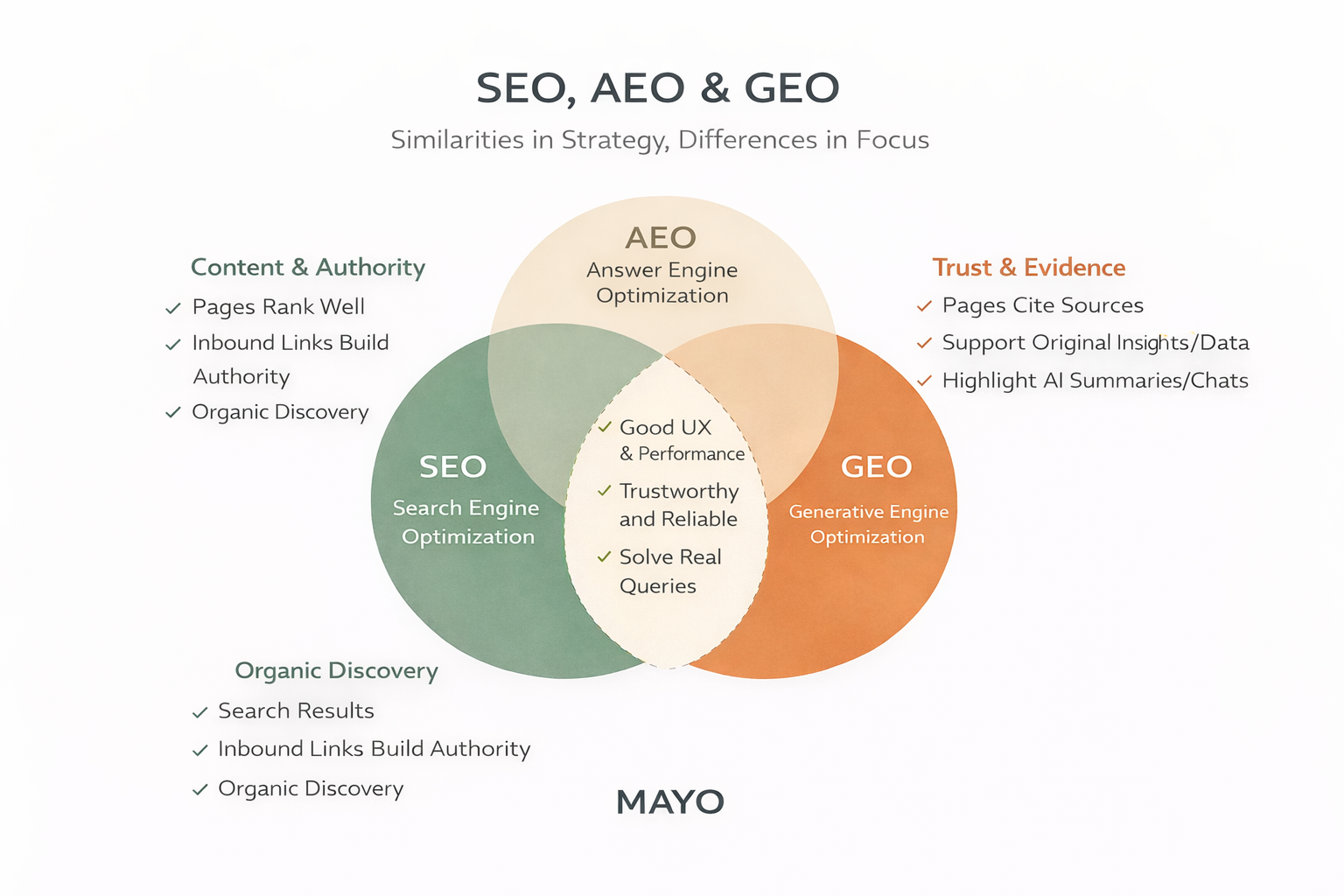
Where SEO, AEO, and GEO Overlap
These strategies are not separate silos. They reinforce each other.
- Strong SEO increases the likelihood that your content is discovered.
- Strong AEO increases the likelihood that your content is extracted.
- Strong GEO increases the likelihood that your content is trusted and reused.
The most effective content sits at the intersection of all three.
This is where brands move from chasing rankings to becoming sources of truth.
Measuring Success in a Changing Search Landscape
Traditional metrics like rankings and clicks still matter, but they no longer tell the full story.
A more complete measurement approach includes:
- Organic impressions and ranking stability
- Featured snippet and answer visibility
- Growth in branded searches
- Mentions or citations in AI-generated responses
- Assisted conversions influenced by search exposure
Visibility today is not always linear. Influence often precedes traffic.
How to Prioritize as a Small or Mid-Sized Business
You do not need to do everything at once.
A practical starting point looks like this:
- Strengthen SEO fundamentals on core pages
- Add clear answer sections to high-value content
- Improve clarity, sourcing, and authority signals
- Update existing content rather than chasing volume
Depth beats scale. Precision beats noise.
This is where smaller teams often outperform larger competitors.
The Bigger Picture
Search is changing quickly, but the goal has not changed. Your brand still needs to be found, understood, and trusted by the right people at the right moment. Whether you are refining an existing SEO strategy or rethinking how your content performs in answer-driven and AI-powered search, having a clear plan makes all the difference.
If you want help navigating SEO, AEO, and GEO in a way that aligns with your business goals and values, we’re here to help. Reach out to the MAYO team to start a conversation about building long-term visibility that grows with your brand.